



The time machines: inside Melbourne’s last analogue photo booths
In a modern age defined by the ease of shooting and sharing photos on social media – archaic analogue photo booths stand as a complete antithesis. Heavy, slow and temperamental, they rely on chemicals and mechanical technology invented more than fifty years ago. There is actually a lot going on inside these booths – they are basically a portrait studio and B&W print lab packed into a 2 x 2 x 1 meter half tonne box.
The business Metro Auto Photo operates seven photo booths around Melbourne and the team puts a lot of time, sweat and tears into keeping them all running.
Surprisingly, visiting the booths has become insanely popular – especially with the Z Generation.
Previously operated by Alan Adler – Australia’s 'most photographed man' – these iconic photobooths have become city landmarks. Beyond the image itself, the four-minute chemical process creates a ritualistic experience, capturing a tangible moment in time. These booths aren't just cameras – they are veritable time machines.
A new chapter

Today, the heritage of these vintage treasures is in the hands of Chris Sutherland and Jessie Norman.
The pair, who established Metro Auto Photo in 2022, first crossed paths with Adler in 2018 when they saw a note on the Flinders Street booth stating it was scheduled for removal. They successfully campaigned to save it and, in the process, became Adler’s unofficial protégés.
Under their stewardship, the business has expanded beyond Flinders Street to locations such as Lygon Court, South Melbourne Market, and The Curtin. They have dedicated themselves to the complex restoration of machines that had sat in storage for decades, ensuring that the 'wet' chemical process (a rarity in a digital world) continues to thrive.
Their team currently consist of:
Chris: Head of tech & chemistry
Jessie: Admin & baby tech
Riley: Tech & mechanic
The analogue ritual
The magic of a Metro Auto Photo strip lies in the traditional silver halide process. Unlike modern digital booths that use thermal printers, these machines are genuine analogue artefacts. They produce high-contrast, black-and-white strips that possess a depth and grain that digital sensors cannot replicate.
Because they use real chemistry, the strips emerge slightly damp and smelling faintly of 'fixer' – a sensory reminder of the physical art of photography. (You can read more about the intricacies of the process at the end of the interview)
A strip from a Metro booth is more than a souvenir – it is a permanent record and a tangible object. They are not images that sit buried in your phones or computers hard drives. They live in the physical realm often in the most cherished place in a persons home – the fridge door. These chemical prints are remarkably archival, often outlasting the hardware of our smartphones.

Q&A with Chris Sutherland
Recently, Capture caught up with Chris at Flinders St booth to quiz him about what it's like running these archaic, yet wonderful machines.
1) The Mentorship & Succession
You spent five years apprenticing under Alan Adler before taking over. What was the most 'old-school' or surprising piece of advice he gave you about keeping these machines alive that you couldn't find in any manual?
It took years of turning up to Flinders St and working out his routine – to try and catch him to chat about the possibility of interviewing, or filming him for a documentary.
So years of chasing him around and filming him turned into a five-year friendship as well as learning the machines inner workings and his ‘hacks’ along the way.
To be honest, he 'frankensteined' the machines so much that I’d open up the original manuals, and they were not much help as so many original parts were missing or replaced with a part 30 years younger, or one of Alan's own custom ideas. So it was trying to learn a half century old machine, and then Alan’s brain of why he made certain modifications.
I suppose it was his ‘Macgyver’ way of thinking (maybe this reference is getting too old for people to know). He was always looking around for solutions rather than purchasing new things.
This stems from him being a depression-era child and using what you had out of necessity. Mostly things within reach were put to use. Discarded cans or rubbish that could be manipulated to help serve a purpose inside the machine.
Adopting this approach and way of thinking has helped in emergencies. Such as the opening day of our exhibition I had to fix the Photobooth camera with some things on the floor around me. A found bobby-pin, a can pull-tab and some tape helped me fix a microswitch... which I just realised is still keeping that camera running months later.

2) Modern VS old-school booths
You mentioned that many people’s first port of call to Melbourne is the Flinders St booth. Staying in a hotel across the road from it, we witnessed queues throughout the day. What makes it so popular – as compared to the modern digital sticker booths that you see in Asia?
There has been an analogue photobooth at Flinders St Station for over 65 years, Alan ran them for 50 of those years after purchasing them off the previous owner who had the location.
You don’t have to wait for anything nowadays, in the 60's or 70's when most of our machines were made, 3 minutes was considered 'instant!'. Now we get emails daily from people who think the machine is broken but they haven’t waited longer than a minute.
People don't read instructions – they expect a touch screen to walk you through. But this waiting time actually has a affect on people and creates anticipation and excitement. It also forces people to chat with strangers as they wait.
There’s something special about not knowing how it’s going to turn out. There’s a fixed lens, the magic of chemistry and light with the complex system of moving parts inside all working hard to deliver this special one of one developed portrait. There's no digital footprint or record unless you put it online… which is a bit of irony.

3) Supply chain hurdles
Worldwide, there are only about 250 of these chemical booths left. Is it a constant battle to source the specific silver-halide paper and chemicals needed, or have you had to find modern alternatives that still fit the vintage internal chemistry?
Photobooth owners have come together as a community (there are only about 60 people worldwide who know how to run these machines) to find a solution as the dedicated paper was made in Russia.
Back when we got the keys off Alan and our life savings was handed over… we were so excited to continue his life's work. But that very week Russia invaded Ukraine and the ability to purchase materials from Russia suddenly stopped.
So we all had to band together to find an alternative very quickly or else we’d all be out of our livelihoods, and all these machines would have died.
It was an incredibly stressful and uncertain start, and we were only able to survive thanks to Marcin, an operator in Poland who helped send us paper till our industry found alternatives but thankfully we have now a great paper option thanks to Ilford, the long running film and paper company based in the UK.

4) Restoration vs. Resto-modding
Your website mentions 'digital resto-mods.' How do you balance the desire to keep things 100% authentic and chemical with the reality of maintaining 50-year-old electronics? Have you had to 'hack' the machines to accept modern tap-to-pay systems?
The reality is, no one carries cash (especially in Australia) and finding $8 in $1/$2 coins is difficult - even if you prefer cash. So we have added a digital payment systems to most of our booths and updated flash systems to more modern solutions. But apart from that, these machines will hopefully run for another 100 years.

5) Vandalism & public spaces
The Flinders Street booth is an icon, but it's also in one of the highest-traffic (and dodgiest) spots in the city. How do you deal with the reality of vandalism or 'Melbournian' wear-and-tear without compromising the booth's vintage aesthetic?
It’s a daily battle. Every day we have vandalism, bodily fluids, you name it. Probably things you wouldn’t have thought of, I’ve cleaned up. From finding a full size Christmas tree, many people asleep curled up on the floor, or a can of sardines thrown and smushed all over the booth… that was probably the worst thing so far.
It is a shame that every day the Flinders Street Photobooth is graffitied or mistreated in an endless amount of ways. It's the wild west down there and we wish people respected it a little more. There's a lot of emotional attachment to this machine as a part of Alan that is still with us / Melbourne. So the way a lot of people treat it – it's hard not to take that personally.

Image from Metro Auto Photo.
6) The 'Man Behind the Curtain' life
Alan often used to visit his booths early in the morning to take his test strips. Now that you’ve traded your 9-to-5 for this, what does your daily routine look like, and do you still find yourself doing the daily test-strip ritual?
Every day is vastly different. Which keeps things interesting because at times we have to drop everything and get to a booth if it requires the odd paper jam fix, or one of the hundreds of little parts has come loose.
But yes, these machines work 24/7 – so do we. Visits to each booth require at least one test strip, sometimes multiple daily if we have extreme weather temperatures. So we are creating our own vast collection of strips. We have already aged a lot even though it’s only been a few years operating the business – so clearly the stress has taken a toll haha.

'mini-hotel for tired drunks' on numerous occasions. Photo: Tim Levy
7) Previous life & career pivot
Before starting Metro Auto Photo in 2022, you were a professional photographer and videographer. How does the 'perfection' of digital commercial work compare to the beautiful, unpredictable 'mistakes' that happen inside a chemical booth?
We do miss shooting wine all day in our comfy studio and enjoying trips to wineries a little. But the challenge of working in creative industries is the challenge of working with people.
Now if there is a problem with an old photobooth... there is a reason why. There is a physical part that needs fixing and you can deal with that on your own which is nice. Rather than needing to spend hours changing the colour of cheese, or editing a video from scratch again – just because the client changed their mind on the song choice after you finished it.
8) The archive of 'lost' photos
In the Auto-Photo exhibition, there were 'lost' strips that Alan had collected over the years from people who had failed to take their prints. What’s the most bizarre or moving thing you’ve found left behind in a booth since you took over?
We are collecting our own ’lost’ strip collection – which is bittersweet, it’s so lovely to see stranger’s own moments because a lot of the time we don’t get to meet people who use our booths – though through social media we get to hear a lot of stories. Plus we have gotten to reunite people with their strips!
While restoring these machines we find tiny rolled up strips of Alan that he used as shims to wedge parts. Sadly, the more we restore the less of him we find. But regardless, he’s a part of every machine.
Thanks for the chat!
Read further below to find out the history and how chemical photo booths work.
You can also find out more about Metro Auto Photo booths on their website.

The fascinating history of the photobooth
While the very first automated photography machine was patented in 1898, it was plagued by mechanical failures and never achieved the reliability needed for public use. It was not until the mid-1920s that the first truly functional and commercial version of the technology emerged.
The modern concept of the photo booth – later featuring its iconic curtain – was the work of Anatol Josepho (formerly Josephewitz), a Russian immigrant who arrived in the U.S. in 1923. His 1925 debut on Broadway in New York City marked the arrival of the first 'real' photo booth.

The Rise of the Photomaton
For 25 cents, Josepho’s booth would take, develop, and print eight photos in a process lasting roughly 10 minutes. The public reaction was immediate:
- Massive Popularity: In the first six months after the booth was built, it was used by 280,000 people.
- Commercial Expansion: The Photomaton Company was established specifically to place these booths in locations across the country.
- The Million-Dollar Deal: On 27 March 1927, Josepho was paid $1 million for his invention, while also being guaranteed future royalties – a staggering sum for the era.
The photo booth represented a massive leap in accessibility, moving photography out of the formal studio and into the hands of the general public for the price of a few coins.
So how does the photobooth work?
A chemical photobooth – often called an analogue or 'dip-and-dunk' booth – is essentially a miniature, fully automated darkroom squeezed into a cabinet. Unlike modern digital booths that use inkjet printers, these machines use actual old-school light-sensitive paper and liquid chemistry to create the photo in real time.
Here is the step-by-step breakdown of the process
- The Exposure
After inserting your coins or paying by tap, within 15 seconds the flash fires and the lens projects your image directly onto a strip of light-sensitive silver halide paper fed from a large internal roll.
- The 'clunk': That heavy mechanical sound you hear is the shutter opening and a mechanical arm (often called a 'spider') cutting the strip of paper from the roll.
- No 'final' negative: These machines use reversal processing. There is no separate film negative – the piece of paper that light was projected onto is what you take home.
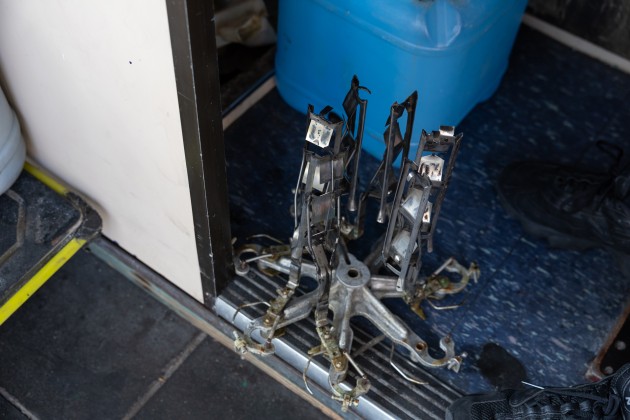
The 'spider' essentially holds the paper and dunks it into the various chemical baths. Photo: Tim Levy
- The mechanical 'spider'
Inside the machine, a complex system of gears, chains, and a rotating arm (the spider) moves the paper strip through a series of tanks. These tanks are filled with different chemical solutions, and the paper is 'dunked' into each for a precise amount of time.

- The 9-Step chemical journey
To get from a blank sheet to a finished photo, the strip usually travels through about nine different stages:
- First Developer: This turns the silver halide that was hit by light into metallic silver, creating a negative image on the paper.
- Bleach: This dissolves away that silver negative, leaving only the unexposed parts of the paper behind.
- Clearing: This neutralises the bleach so it doesn't ruin the next steps.
- Fogging (The Reversal): The machine 'fogs' the remaining silver halide – either by hitting it with a small internal light or using a fogging chemical. This makes the remaining parts of the paper 'developable'.
- Second Developer: This develops the remaining silver, which creates the positive image (the final image)
- Fixer: This 'fixes' the image so it is no longer sensitive to light, making it permanent.
- Wash & Dry: The strip is rinsed in water to remove chemicals and then passes through a heated dryer (essentially a high-powered hairdryer) before being spat out of the slot.
If you want to see how a chemical photobooth works – check this video by Carmencita Film Lab