


Phil Hillyard is one of Australia’s most prolific and celebrated sports photographers, boasting a career that has chronicled the nation’s greatest sporting moments for over thirty years.
A nine-time Walkley Award winner and the first photographer to be honoured with the Australian Sports Commission’s Lifetime Achievement Award, Hillyard has an unparalleled ability to capture the definitive moments of history, from iconic AFL and NRL Grand Finals to the global stage of the Olympic Games.

Renowned for combining technical mastery with an intuitive feel for the human spirit, his images, such as the historic 1,000th goal of Lance ‘Buddy’ Franklin, have become part of the collective memory of Australian sport.
In this conversation, Hillyard reflects on his life behind the camera, the thrill of the front-row seat, and what it takes to find the extraordinary in the heat of the game.
Tell us a bit about your photographic journey
I was quite lucky, I chose this career path when I was a 13-year-old kid. I loved the idea of being able to attend the sport and capture it. From then on I set about achieving it.
I did work experience at the Adelaide News newspaper while I was in school and absolutely loved it. I kept in touch with the photographers and once I completed school I landed a job working in the darkroom at that paper.
Looking back I really had no idea what I was doing in the beginning but I watched, listened and learned from those ahead of me. I did figure out pretty early on, though, that photography is a self-taught profession. You can learn from others and be inspired by them, but you really have to teach yourself.

Who do you work for now & what do you mainly shoot?
These days I run my own business with a few major clients. I primarily cover AFL, which is why I became a photographer in the first place. I love it today as much as I always have.
I still cover cricket but not as much as I used to. I spent over a decade travelling the world with the Australian cricket team. They were fantastic days.
A big part of what I do these days and have done for many years is capturing portraits of the athletes and profiling them. I love the challenge of it. Whether I am capturing big moments in sport or high-quality portraits, I find them equally satisfying.

How much of your job is researching and pre-production?
You need to know what is going on. I read a lot of news about the sports I cover. Knowing the sport you are covering is key. I'm a lot better at photographing the sports I know well than those I don't.
Portrait photography often requires significant planning. Pre location recce, timing of shoots. I always like to know where the light falls and at what time. A lot of it gets stored in your memory for next time.
I also arrive early for everything. Sporting events can become very intense and I like the moments of calmness well before the event starts.

How do you get to know your athletes?
Be present for starters. I'm there well before games start and well after they finish. I'm at the trainings, in the clubs, capturing portraits and always talking to them to earn their trust. I guess I show them that I am committed and equally hardworking at my job.
I could never be the photographer who just turns up, covers an event, and leaves. I needed to get to know them.
I see the game from their side. I have always had empathy for them and what they must go through with the pressures of it all.

It’s impossible to be omnipresent at a sports ground. What is your internal checklist for deciding where to 'plant' yourself for the high-stakes moments of a game?
I will have an initial plan, but you never know what's about to happen in sports, so you need to be ready to make quick decisions. You try to read the play, predict what may happen and position yourself best to summarise the situation.
Can you put a lucky to unlucky ratio to your work? Are there a few standout moments you missed?
That's hard to say. You miss some, but sometimes things just don't run your way.
An example would be if you're covering a cricket Test match and a bowler takes 6 wickets in an innings, all of them while he is running away from the end where you were sitting! This makes it hard to capture the best pictures to sum up the situation and the story of the day.
The other big issue is people getting in the way of the moments: other athletes, umpires, trainers, camera operators! Covering sports presents many challenging situations on any given day.

What are some of your favourite portraits?
- Australian Test Cricket Captains: I've been documenting our captains in a portrait setting for many years and it is something I plan to continue. I have tried to make them similar yet distinct from each other. They are all at the SCG, many shot early in the morning on New Year's Day, ahead of the Sydney Test
- Buddy: Lance Franklin at sunset ahead of the AFL's Sir Doug Nicholls Round.
- Bolt - The Greatest: I captured Usain Bolt after his heat in the 200m at the Rio Olympics. It was a simple study of the greatest sprinter of all time the morning after he won his 3rd straight Olympic Games 100m Gold medal.
- Campbell Sisters: When planning this one I drove up and down Sydney east coast and looked at the all ocean pools to select the location. I chose this one at Dee Why because of the rocks. A simple two-light setup; however, the wind was howling and with no assistant I had to shoot with the light right next to me so I could plant my foot on the lightstand to prevent it from toppling into the water. I always loved working with Cate and Bronte. They were always very willing to help me get the best possible result.
- Sydney Kings Basketball: It's always challenging shooting with studio lighting as the last bit of natural light fades. It changes so quickly and balancing your exposure with the power of the lights is never easy to get right. I mounted a small light to the basketball rim, running a cable over the backboard and taped down the pole to a power pack on the ground. A second light was at ground level on the court looking up.
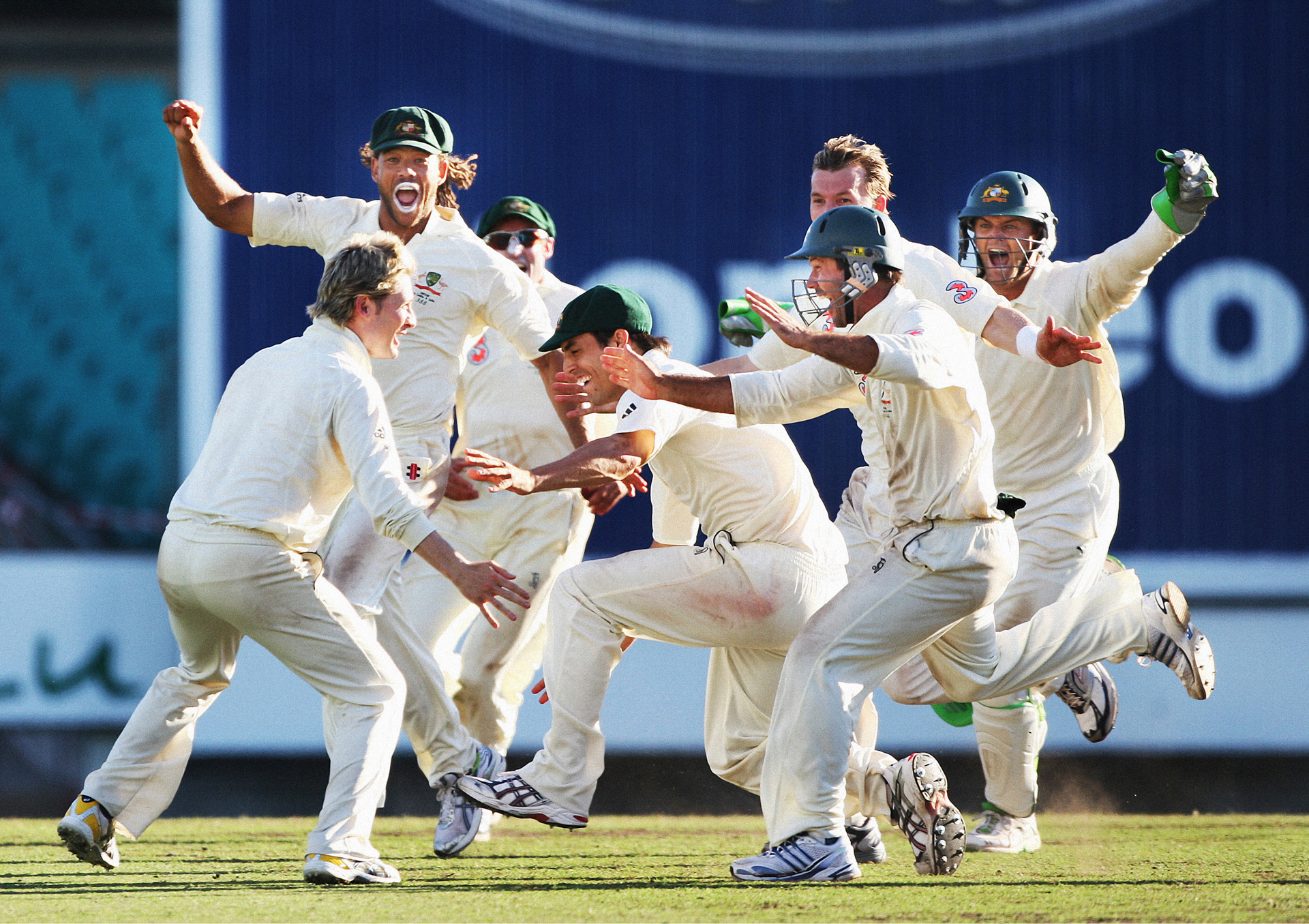
Australia defeats India 2008. Image: Phil Hillyard
What are some of your favourite sports action shots?
- Micky O and fans: The Swans' Michael O'Loughlin gets into the face of the West Coast Eagles fans during the 2006 Qualifying Final at Subiaco in Perth after he kicked the match-winning goal. The Swans winning by a point. It's moments like these we are all trying to capture. A single image that tells the story of the night.
- Victory 16 in a row: Covering a Test match is like no other sport. It is a test of patience. 540 balls a day for five days and any of those balls could be the story of the day or the moment of the Test match. This one went down to the wire between Australia and India at the SCG in 2008. In the final few overs Australia took 3 late wickets and snatched victory from India. This was the final wicket and it was at 6.35pm on Day 5. An epic Test match which equalled Australia's own world record of 16 consecutive Test match wins. It was on the front page of every paper around the country the next day.
- Buddy 1000: Lance Franklin's 1000th goal at the SCG. Probably the greatest moment I have seen unfold through my lens. The build up, the pressure on Bud, Friday night footy, packed house—he marks the ball and I immediately move to choose a position where to capture it. As he prepares to kick a Geelong player walks straight in front of me. Thankfully he moved out of view. As Buddy begins to walk in, the crowd walks behind him, as he begins to run, they run behind him. Left boot. It sails through ... And the place explodes! To see that unfold and the joy on Buddy's face and the ephoria around him was something else. It was an incredible night.
- Tim Cahill: The night Timmy Cahill stood on the fence in front of me. I had a second camera ready if a goal happened. I had a Canon 24-70mm set to about 50mm which I had pre set as this was the distance to the corner post where Cahill would do his trademark celebration if he scored. He scored the goal and ran towards the post only to take a sharp left turn and jump on the advertising boards in front of me. 50mm was way too tight for this. One handed I zoomed out to 24mm and captured this split second image before he jumped down. It was such an unexpected moment and the image has always been a favourite of mine.

How has technology such as eye-tracking focussing / eye control auto focus made a difference to shooting?
The eye tracking is great, especially when shooting portraits. I can be shooting shallow depth of field and not even be looking through the viewfinder and the focus will track on the subject. The cameras just keep on getting better.
We have gone from shooting film at 5 frames-per-second (FPS) to now using electronic shutter at 40 FPS. Has this insane amount of FPS made you overshoot?
So many frames! I started on film and we used to have a roll of 36 exposures. You had to conserve frames or 'wind-out' and load another film to make sure you would be ready to capture the big moments. It is great though now. We get a lot more pictures to capture that decisive moment.
Now that we have 'Assisted Culling' in editing software such as Lightroom / Aftershoot / Narrative Select / Retouch4me – do you use it to help narrow your images down to find the 'hero' shots? Or do you just use Photo Mechanic?
I edit with Photo Mechanic and don't use assisted culling.
When shooting a match – do you share your images with a media team via ethernet? What is the process?
For most events, we use stadium Wi-Fi to transmit. Big events are cabled to where the photo positions are.

What are the lenses you primarily shoot with?
I use so many different lenses and generally pack more than I need, however I like to arrive at a shoot with an open mind and avoid pre-planning which lens I will use. For the big sports I usually use the same lenses.
• Cricket: EF 600mm f/4L IS USM
• AFL: EF 500mm f/4L IS USM
• Football: RF 100-300mm f/2.8L IS USM
• EF 400mm f/2.8L IS USM is great for many sports.
For portraits I use a variety but an old favourite is still my Canon EF 85mm f/1.4L IS USM
For the camera bodies I use: Canon EOS R1, EOS R3 and EOS R5 MKII
Do you have any new projects you are currently working on?
We are always working on something, but regarding personal projects, not really at the moment. However, when I get away on vacation after a small break from the camera I love to take it out and shoot street and travel pictures. It's a passion I have had for a long time. It's a great lesson for your eye on composition which is the key to great photography.
Thanks so much for your time!
