


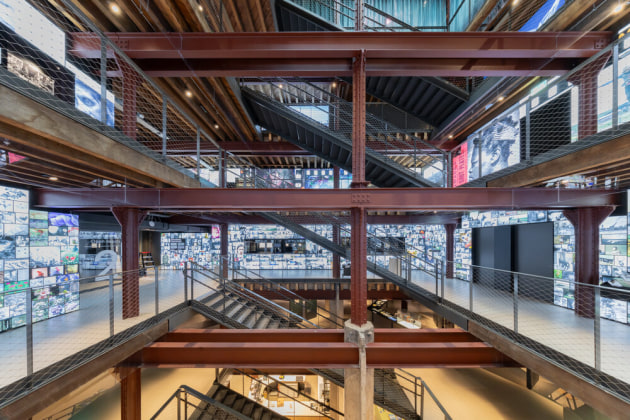
The Nederlands Fotomuseum has officially reopened within the historic Santos warehouse, a national monument in Rotterdam’s vibrant Katendrecht district. Originally constructed between 1901 and 1902, the building first served as a storehouse for coffee arriving from the Brazilian port city of Santos.
The museum’s origins trace back to Hein Wertheimer, a dedicated amateur photographer whose own work reflected the humanistic style of masters like Henri Cartier-Bresson and Robert Doisneau.
Upon his passing in 1997, Wertheimer left the majority of his estate to the Prince Bernhard Culture Fund. This led to the establishment of the Wertheimer Fund, which provided a €11.2 million bequest to found the museum, which originally opened in May 2007 in the Las Palmas building.

From its inception, the museum has remained committed to the core pillars of the craft: collecting, preserving, researching, and exhibiting Dutch photographic heritage. This new location provides a significantly grander stage to showcase the nation’s visual evolution, featuring a mix of established Dutch masters and emerging talent. The collection offers an exhaustive timeline of the medium, spanning from its dawn in 1839 to the present day.
A warehouse of over six million images
The new Museum spans approximately 9,000 square metres across nine floors, which is a significant upgrade from its previous location, allowing the museum to better showcase its massive collection of 6.5 million objects.
The space is roughly divided as follows:
Public Space: Over 5,000 square metres is dedicated to public areas, including the café, bookshop, and educational facilities.
Exhibition Space: Nearly 3,400 square metres is reserved strictly for exhibitions, including the permanent Gallery of Honour.
Archival & Conservation: The remaining area houses state-of-the-art climate-controlled storage and restoration workshops, many of which are now visible to the public through glass walls.

The Heavyweights: From Van er Elsken to Corbijn
You cannot discuss Dutch photography without acknowledging the giants who paved the way. The museum’s reopening centres on a ‘Gallery of Honour’, featuring 99 works that define the medium.
Foremost among them is Ed van der Elsken, the ‘enfant terrible’ of Dutch photography. His gritty, cinematic street photography in the 1950s – particularly his book Love on the Left Bank – set a template for documentary shooters that is still being emulated today.
Then there is Cas Oorthuys, whose work during the ‘Hunger Winter’ of WWII remains some of the most haunting photojournalism ever produced.
On the contemporary side, the museum pays homage to the likes of Anton Corbijn. Long before he was a world-renowned film director, Corbijn’s high-contrast, moody portraits of icons like U2 and Depeche Mode defined the aesthetic of an entire generation. His ability to find the human beneath the ‘celebrity’ is a masterclass in portraiture that any aspiring professional should study.
A comparison to our own Museum of Australian Photography
Back on home soil, and on a more intimate scale, we are exceptionally fortunate to have the Museum of Australian Photography (MAPh). Formerly known as Monash Gallery of Art, this purpose-built institution in Melbourne remains a vital custodian of our photographic history.
Spanning 1,000 square metres, it houses a permanent collection of over 4,000 nationally significant works.
It is a fascinating point of comparison: the Netherlands supports a 9,000 square meters multi-level warehouse dedicated to the craft with a population of 18.2 million, while Australia, with over 27 million people, maintains a more boutique, specialised approach with it's 1,0000 square meters.
However, what MAPh lacks in sheer warehouse footprint, it makes up for in architectural intent. Designed by the late Harry Seidler, the building itself is a wonderful example of modernist architecture, proving that even a 'smaller' scale can carry immense cultural weight.
From our vantage point in Australia, the reopening of a institution like the Nederlands Fotomuseum is a shared victory. It reinforces a crucial argument for our local industry: photography deserves its own 'cathedral'.
It shouldn't merely exist as an ‘add-on’ or a secondary wing of a state art gallery. Photography is a medium so accessible and widely embraced by the public that it has earned its own dedicated, monolithic institution.
You can find out more on the Nederlands Fotomuseum website.
Also – you can read the Capture behind-the-scenes feature on the Museum of Australian Photography here.